.png)
Why Adult Braces and Invisalign May Need TMJ Neuromuscular Therapy
Adult orthodontics can be amazing. It can save teeth, improve bite mechanics, make cleaning easier, and yes, help people feel better about their smile.
But there is a part of the conversation that often gets skipped: your jaw joint and muscles still have to live through the process.
Lately, I have noticed more clients coming into the office with Invisalign aligners, retainers, or adult braces who are also dealing with neck tension, shoulder pain, headaches, jaw soreness, or that “my bite just feels off” feeling. Sometimes the discomfort tracks with tooth movement. Sometimes it seems tied to the way the teeth come together while plastic trays or brackets are in the mouth.
This does not mean braces or Invisalign are bad. It means the jaw, neck, and shoulders may need extra support while the mouth is changing.
This post is informational only and is not medical or dental advice. If you have jaw pain, headaches, gum changes, or bite changes during orthodontic treatment, talk with your orthodontist, dentist, periodontist, or another qualified health professional.

Orthodontic work changes more than your smile
When adults start braces or Invisalign, the main focus is usually the teeth. That makes sense. Teeth are the visible thing being moved.
But the teeth are not floating in space. They are part of a larger system that includes:
The jaw joints, also called the TMJ
The chewing muscles
The tongue
The neck and throat muscles
The shoulders and upper back
The nervous system
Posture and breathing habits
When an orthodontic appliance changes where the teeth sit, the muscles have to keep adapting. They may tighten, guard, or overwork while trying to find a new “normal.”
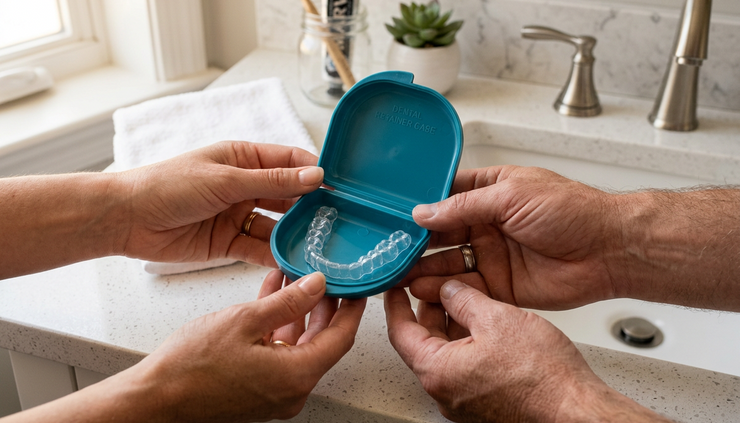
With clear aligners, there is another layer. The teeth are not just moving. They are also covered by plastic for many hours a day. That plastic can slightly change the space where the upper and lower teeth meet.
For some people, that is no big deal. For others, the jaw does not love it.
The pressure may show up as:
Jaw joint aching
Clicking, popping, or catching
Headaches near the temples
Neck stiffness
Shoulder tension
Ear pressure or fullness
Tooth sensitivity
A tired feeling in the face
Clenching more than usual
Again, this is not always a sign that something is “wrong.” Orthodontic movement can come with some discomfort. But ongoing pain, worsening headaches, or new TMJ symptoms should not be brushed aside as just part of the process.
Why adult jaws may need extra support
Adult orthodontics is different from childhood or teen orthodontics. Adult bones, joints, muscles, and habits have had more time to settle into patterns.
Maybe there has been years of clenching. Maybe a tooth has been missing. Maybe the bite has shifted around crowns, gum changes, or old dental work. Maybe posture, stress, sleep, or breathing patterns have been feeding jaw tension for a long time.
Then braces or aligners come in and ask the system to change.
That can be a lot.
The TMJ is not just a hinge. It is a small, complex joint that has to glide, rotate, absorb pressure, and coordinate with muscles on both sides of the head and neck. When the bite changes, the jaw joint may need time and support to adapt.
This is where TMJ neuromuscular therapy can be helpful.
Neuromuscular therapy, often called NMT, focuses on how muscles, nerves, fascia, and movement patterns interact. In the context of orthodontic treatment, the goal is not to move the teeth. That is the orthodontist’s job.
The goal is to support the soft tissue system around the jaw while the teeth are being moved.
That may include work on:
The muscles of the jaw and face
The temples
The neck
The shoulders
The upper back
The muscles inside the mouth when appropriate
Breathing and resting jaw position
Patterns of clenching or guarding
A 60-minute follow-up session can give enough time to address more than just “my jaw hurts.” The jaw is often the loudest area, but the mid back, neck, shoulders, and head can all be part of the same pattern.

My own braces experience changed how I see this
I want to be clear. I am not anti-braces.
My original reason for getting braces was not cosmetic. I was trying to save a tooth that was being pushed out of the jaw bone. That mattered to me. I was willing to do the work, pay the money, and go through the discomfort if it helped protect that tooth.
But my experience was rough.
I had brackets on for about a year. Even though the language around the treatment was all about “proper alignment,” I kept feeling like the TMJ side of the story was being missed. The focus seemed to stay on tooth position and cosmetics, while my jaw joint was getting more irritated.
Over time, I developed chronic TMJ pain and frequent headaches. At my periodontal cleanings, the pocket around all of the teeth were getting worse every three months.
That was scary and frustrating. The whole point was to protect the tooth.
I had to keep reminding the orthodontic office, “I am here to save this tooth. I am not here for perfect teeth.”
Eventually, I had the braces removed a year earlier than planned because the joint pain, headaches, and periodontal changes were not something I could ignore.
After the brackets came off, I was given plastic tray retainers. Those retainers made the pain and headaches significantly worse when I wore them as directed. The recommendation was full-time wear for the first six months, but my body was clearly not handling that well. I shifted to nighttime wear only.
Two months after the braces came off, I went back to the periodontist.
The pocket depth had reversed.
Yes, reversed in two months.
That was a big moment for me. It did not magically answer every question, but it made one thing very clear: my body was responding to the appliances, and the jaw and periodontal tissues needed to be part of the bigger treatment conversation.
I am still working on my jaw mobility with NMT. I am also still trying to figure out how to protect the investment I made in my teeth without creating long-term TMJ issues from the retainers.
That is the messy middle a lot of adults find themselves in. You want the benefit of orthodontic treatment, but you also have to listen when your body says the plan needs adjusting.
Pain during orthodontics should be taken seriously
Some soreness is expected when teeth move. Aligner changes can make teeth ache. Braces adjustments can make chewing uncomfortable. That is common.
But there is a difference between temporary tooth soreness and symptoms that keep building.
Pay attention if you notice:
Headaches that become more frequent
Jaw joint pain that does not settle
New clicking with pain
Trouble opening the mouth
A bite that feels unstable or forced
Neck and shoulder pain that started with treatment
Clenching that gets worse with trays or retainers
Gum changes or periodontal concerns
These symptoms do not automatically mean you need to stop orthodontic treatment. They do mean the plan deserves a closer look.
Sometimes the answer may be simple, like adjusting tray wear timing, checking the bite, smoothing a high spot, changing retainers, or slowing treatment down. Sometimes it may involve more support from a bodywork perspective.
The main point is this: you are allowed to advocate for comfort and function, not just the final look of the teeth.
If your orthodontic team is focused only on the end result, keep bringing the conversation back to your original goal. For some people, that goal is cosmetic. For others, it is saving a tooth, improving gum health, reducing crowding, or making dental care easier.
Your plan should match your goal.
How TMJ neuromuscular therapy can support the process
TMJ neuromuscular therapy does not replace orthodontics. It works alongside it.
Think of it like this. Orthodontics moves the teeth. Neuromuscular work helps the muscles and joints adapt to the changes around them.
During adult braces or Invisalign treatment, NMT sessions may focus on calming overactive muscles and improving mobility through the jaw, neck, and upper back. The work can be external, internal, or both, depending on training, consent, and what is appropriate for the client.
A session may include gentle work with:
The masseter muscles along the jaw
The temporalis muscles at the temples
The pterygoid muscles, which can be involved in jaw tracking and clenching
The suboccipitals at the base of the skull
The SCM muscles along the front and side of the neck
The upper traps and shoulders
The chest and upper back when posture is feeding tension
Internal jaw work can be especially useful for some TMJ patterns because certain jaw muscles are easier to access from inside the mouth. This should always be done with clear consent, proper hygiene, and good communication.
A 60-minute follow-up session is often a great fit because it allows time to treat the whole chain. If the body is constantly changing because of an orthodontic appliance, the muscular system may need more frequent check-ins than it normally would.
This is one of the few situations where I may recommend more frequent visits for a period of time. Not forever. Not because everyone needs the same schedule. But because the body is actively shape-shifting, and waiting too long between sessions may allow the tension pattern to dig in again.
The goal is to help the system stay adaptable.
That may mean:
Less jaw guarding
Better opening and closing mechanics
Reduced neck and shoulder compensation
Fewer tension headaches
More awareness of clenching habits
A clearer sense of when something in the orthodontic plan feels off
Some people feel relief quickly. Others need steady work over time. The response depends on the person, the appliance, the bite changes, stress levels, sleep, history of jaw issues, and how much the muscles are guarding.
You need to be the advocate for your own jaw
This part is hard, but it matters.
Many orthodontic offices are great at their specific skill set. They know teeth. They know movement patterns. They know how to guide a smile into a planned position.
But that does not always mean they are watching the jaw joint, neck, shoulders, headaches, gum changes, and whole-body response with the same level of attention.
If something feels wrong, bring it up clearly. If it keeps happening, bring it up again.
You can say things like:
“My jaw pain has increased since starting this tray.”
“My headaches are more frequent with the retainer.”
“My neck and shoulders are flaring after aligner changes.”
“My original goal is to save this tooth, not to chase cosmetic perfection.”
“Can we review whether this plan is still working for my body?”
“Can we check how my bite is landing with the trays in?”
“Can my dentist or periodontist be looped into this conversation?”
Write symptoms down. Track when they show up. Notice whether pain changes with a new tray, after long wear time, during stress, or after sleeping in retainers.
You do not need to be dramatic. You do need to be consistent.
Orthodontic treatment is a big investment of time, money, and energy. Protecting that investment includes protecting your jaw.

The takeaway for adults with braces or Invisalign
Adult orthodontics can be the right choice and still be hard on the jaw.
If you are using braces, Invisalign, or retainers and noticing TMJ pain, headaches, neck tension, or shoulder discomfort, do not ignore it. Those symptoms are information. They may be telling you that your muscles and joints need more support while your teeth are moving.
TMJ neuromuscular therapy can be a helpful part of that support plan, especially when sessions address the mid back, neck, shoulders, and jaw together. It gives the body a chance to adapt instead of just brace against constant change.
Keep working with your orthodontist. Stay in touch with your dentist or periodontist when gum health is involved. And keep advocating for the reason you started treatment in the first place.
Perfect teeth are not worth chronic pain. A good plan should respect the teeth, the jaw, and the person attached to both.



Comments